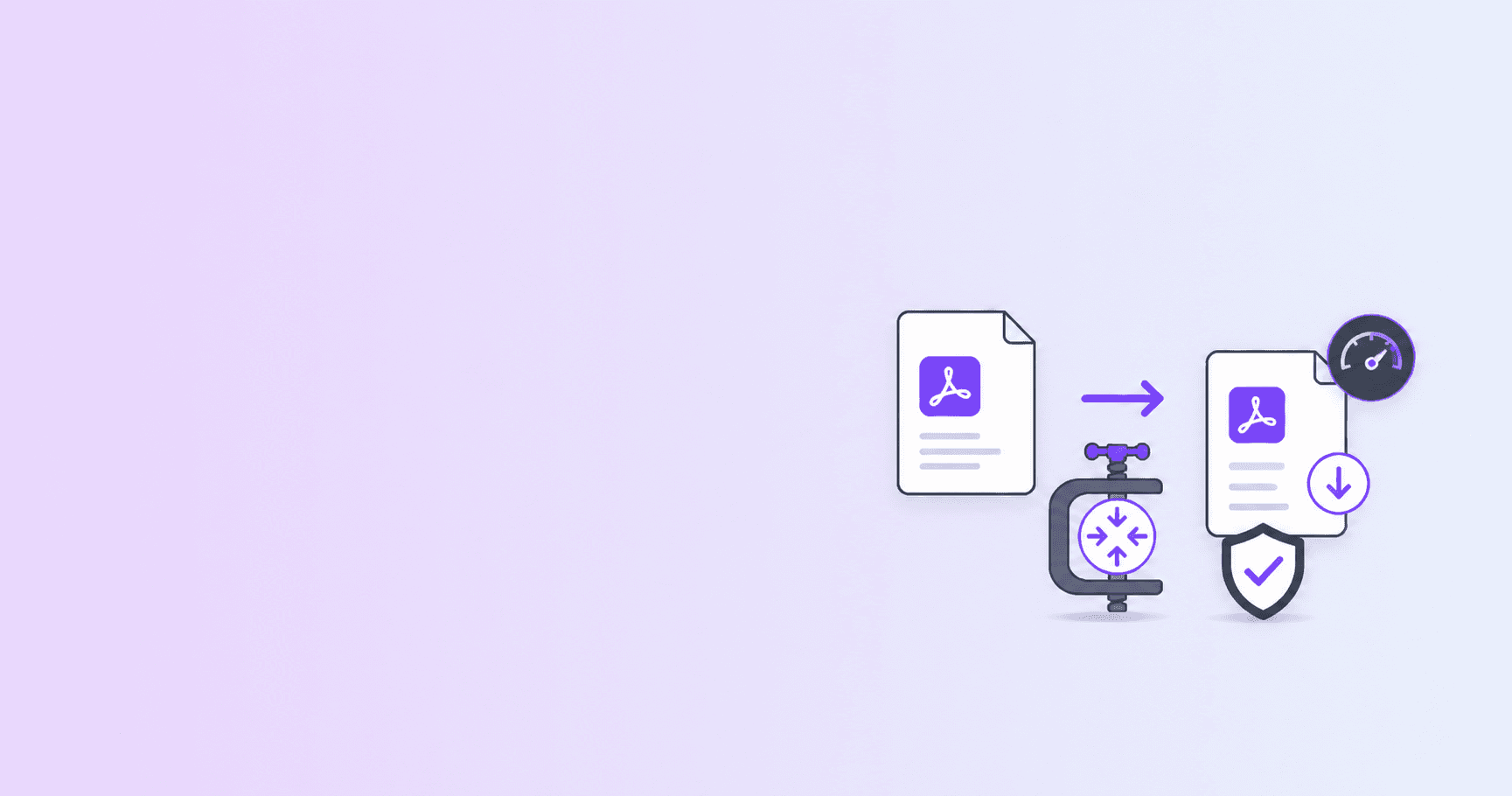
File size limits are everywhere. Job portals that refuse PDFs over 2MB. Email attachments that bounce at 10MB. Government forms that cap uploads at 5MB. WhatsApp that manhandles your carefully formatted document into something unrecognizable.
There's a specific frustration that comes from having a document that's just over the limit. You've done the work. The content is right. And now you're stuck fighting with a file size counter.
This guide is about hitting specific targets. Whether you need a PDF under 1MB, 2MB, or 5MB, here's a practical approach that actually works.
Start By Diagnosing What's Making It Large
Before you compress anything, it's worth spending 60 seconds understanding why the file is large. That tells you which approach will actually work.
Count the pages. A 5-page text document has no business being over 1MB. If it is, the culprit is almost certainly embedded images. A 50-page document full of scanned pages, on the other hand, might legitimately be 30MB and getting it below 5MB will take some effort.
Look at the content type. There are three main categories:
Text-heavy documents (reports, contracts, proposals with minimal images) are naturally small and compress quickly. A 20-page text document might be 800KB before compression and 300KB after.
Image-heavy documents (brochures, presentations with graphics, design files) can be large and compress well. A 10-page brochure at 15MB might compress to 3MB on Basic or 1.5MB on Strong.
Scanned documents are images of text — every page is a photograph. These are the most variable. A 10-page scan might be 8MB and compress to 1.5MB, or it might be 25MB and only get to 4MB. It depends on the scan resolution and the content of each page.
Check for unnecessary pages. A lot of large PDFs have blank pages, duplicate pages, cover sheets, or appendices that the recipient doesn't need. Every page you remove before compressing is a page that can't inflate the file size.
The Step-by-Step Process
Here's the method that consistently gets the smallest possible file:
Step 1: Remove pages you don't need
Before compressing, open the document and ask yourself: does the recipient actually need every page? If not, use the Remove PDF Pages tool to strip out anything unnecessary — blank pages from scanner feeds, internal cover sheets, appendices that aren't relevant to this submission, draft version notes.
This step is often more impactful than compression itself. Removing 5 image-heavy pages from a 20-page document can cut the file size by 40% before any compression happens.
Step 2: Compress with the right level
Upload the trimmed document to the Compress PDF tool. You'll see two main options:
Basic compression targets a 40–60% reduction while keeping the document looking essentially identical to the original. Use this for anything where appearance matters — client reports, resumes, professional documents.
Strong compression pushes for 70–85% reduction by more aggressively resampling images. The difference is visible if you zoom in on photos, but for typical office documents, the result is still perfectly readable and professional-looking. Use Strong when you have a hard size limit to hit.
Download the result and check the file size. If you've hit your target, you're done.
Step 3: If it's still too large, iterate
If one round of compression doesn't get you to your target, here are the additional options in order of impact:
Remove more pages. Even a single image-heavy page can add hundreds of kilobytes. If you removed obvious junk in step 1, look harder — is there a page with a large chart or photograph that could be sent separately?
Split the document. If you have a large document with a hard size limit, splitting it into two or three sections using the Split PDF tool and sending them separately is a completely valid approach. Not always convenient, but it always works.
Accept a higher limit. Sometimes the target simply isn't achievable without unacceptable quality loss. A 40-page scanned manual probably can't get below 1MB — at that point it's worth contacting whoever set the limit and asking if there's an alternative submission method.
Specific Size Targets
Let's get concrete about what's actually achievable for different document types.
Getting under 5MB
This is achievable for almost any PDF with Strong compression. Even a 30-page scanned document at 15MB will usually land well under 5MB after one round of Strong compression. If it doesn't, removing a few of the most image-heavy pages usually finishes the job.
Getting under 2MB
This is achievable for most PDFs if you're willing to remove unnecessary pages and use Strong compression. For image-heavy documents, you may need to do both — compress and remove pages. For text-heavy PDFs, Basic compression often gets you under 2MB from a 5–8MB starting point.
Scanned documents are the wild card. A high-resolution scan of a handwritten form might be 3MB per page, in which case even one page will be above 2MB. In those cases, you may need to re-scan at a lower resolution (150 dpi is fine for most uses) before converting to PDF.
If 2MB is your exact upload limit, use the focused Compress PDF to 2MB guide.
Getting under 1MB
This is the trickiest target and depends heavily on the document. Here's an honest assessment:
Definitely achievable: A 1–5 page text-heavy document (contract, letter, short report). These often hit under 1MB with Basic compression.
Usually achievable: A 5–15 page mixed document (some text, some images). Strong compression plus removing any unnecessary pages usually gets there.
May not be achievable: A document with full-page photographs or high-resolution scans on every page. At some point, you'd need to reduce the visual quality so much that the document becomes hard to read.
If you're hitting a 1MB limit on a government or institutional portal and can't get there, it's worth calling their support line — many portals have a backdoor for larger submissions that isn't advertised, or they'll accept multiple smaller files.
What Compression Actually Does
It helps to understand what's happening so you can set realistic expectations.
PDF compression works primarily by resampling embedded images. A photograph originally stored at 300 dpi (print quality) gets resampled to 150 dpi (screen quality) or lower. The image takes up less space because there's less data representing each inch of the image.
Vector content — text, charts drawn with lines, shapes — is not affected by compression. These elements are stored as mathematical instructions rather than pixel grids, so they're already extremely compact and render sharply at any size.
This is why text-heavy documents compress less dramatically than image-heavy ones: there isn't much image data to reduce. And it's why compression never makes text blurry, even at the most aggressive settings.
One More Thing: Check What You're Starting With
Occasionally people try to compress a PDF and find it doesn't get smaller at all. This almost always means one of two things:
The PDF was already compressed. If someone sent you a PDF that was already optimized before you received it, there's nothing left to compress. In that case, removing pages is your only option for reducing size.
The PDF is mostly vector content. A PDF of a simple text document might already be 400KB, which can't really be reduced further because the content is already as compact as it can be.
In both cases, splitting the document or removing pages is the right path forward rather than trying to compress further.
Advanced Compression Techniques for Technical Users
If basic compression doesn't achieve your target, these advanced strategies can help:
1. Image Resampling & Compression
Most PDF size comes from embedded images. Beyond general compression, you can:
Understand image resolution targets:
- 300 DPI: Professional print quality, unnecessary for most digital use
- 150 DPI: High-quality screen viewing, recommended for archival
- 96 DPI: Standard web quality, suitable for email/portal submission
- 72 DPI: Minimum acceptable for readable documents
Resampling images from 300 DPI to 150 DPI typically cuts image file size by 50-75% without noticeable quality loss for digital viewing.
JPEG compression quality levels:
- Quality 90-100: Nearly lossless, large files (use for photos)
- Quality 75-85: Balanced, small files with minimal visible loss
- Quality 60-75: Aggressive compression, visible artifacts possible
2. Font Subsetting
Some PDFs embed complete font files (hundreds of KB) even when using only a few characters. Subsetting extracts only the characters actually used, reducing file size by 30-40% without affecting appearance.
This is particularly common in PDFs generated from Adobe InDesign or with extensive international character support.
3. Removing Embedded Data
PDFs sometimes contain embedded:
- Form field data (previous form submissions)
- Annotations and comments (reviewer notes, markup)
- Metadata (document properties, revision history)
- Color profiles (device-specific ICC profiles you don't need)
Removing this unnecessary data can reduce size by 5-15%.
4. Stream Compression Settings
PDF content streams can be compressed using different algorithms:
- FlateDecode: Standard ZIP-like compression, lossless, 40-60% reduction
- ASCII85Encode: Text-safe encoding, adds overhead (usually skip)
- Predictor algorithms: Pre-process data for better compression ratios
Most tools use FlateDecode by default, but advanced users might experiment with Predictor algorithms for specific document types.
5. Batch Processing Strategy
For production workflows with many PDFs:
- Analyze first, then process: Test compression on a sample document to predict file size results before processing entire batch
- Set realistic targets: Understand that some documents physically cannot hit arbitrary size limits without unacceptable quality loss
- Automate removal first: Remove unnecessary pages programmatically before applying compression
- Chain operations: Remove → Compress → Verify → Package
Compression Algorithm Comparison: The Numbers
Here's a real-world comparison of compression performance on different document types:
Test Document: 20-page Marketing Brochure
| Original Type | Start Size | Basic Compression | Strong Compression | Size Reduction | Quality Impact |
|---|---|---|---|---|---|
| Design-heavy (90% images) | 45 MB | 12 MB | 6.2 MB | 86% | Minor softening of gradients |
| Mixed text/charts (60% images) | 18 MB | 5.2 MB | 2.8 MB | 84% | Text remains crisp, photos soften slightly |
| Mostly text (30% images) | 3.2 MB | 1.8 MB | 1.1 MB | 66% | Virtually imperceptible quality loss |
Test Document: 100-page Scanned Textbook
| Scan Resolution | Start Size | Basic Compression | Strong Compression | 1MB Achievable? |
|---|---|---|---|---|
| 600 DPI (professional archival) | 320 MB | 95 MB | 48 MB | ❌ No — rescan at 300 DPI first |
| 300 DPI (standard high-quality) | 120 MB | 35 MB | 18 MB | ❌ No — would need to remove 60+ pages |
| 150 DPI (screen quality) | 45 MB | 12 MB | 6 MB | ✅ Possibly with page removal |
| 100 DPI (web quality) | 15 MB | 4 MB | 2 MB | ✅ Yes, achievable |
Key Insight: For scanned documents under 1MB, you're often better off re-scanning at appropriate DPI rather than aggressive compression, because resolution loss will be extreme.
Industry-Specific Compression Strategies
Different use cases have different compression requirements:
Legal Documents
- Goal: Reduce size while maintaining absolute accuracy and evidence integrity
- Approach: Remove pages (cover sheets, internal memos) rather than compress images
- Why: Compression artifacts could be challenged in court; page removal has no legal ambiguity
- Target: Typically 2-5MB per document is acceptable; 1MB rarely required
Financial Reports & Tax Documents
- Goal: Reduce size for portal submission while keeping charts/tables clear
- Approach: Basic compression + optional page removal of appendices
- Why: Numbers and charts must be readable; slight image softening is acceptable
- Target: Usually 2-3MB is acceptable for multi-page documents
Email & Portal Submissions
- Goal: Achieve arbitrary size limit (often 5-10MB)
- Approach: Aggressive compression acceptable; final quality less critical
- Why: Recipient just needs readable content, not professional print quality
- Target: Hit the limit specified by the portal; usually achievable with Strong compression
Medical Records & Healthcare
- Goal: Long-term archival with readability guarantee
- Approach: Minimal compression to preserve image detail; remove pages instead
- Why: Medical records must remain readable 20+ years; compression artifacts may hide details
- Target: File size less important than preservation; use PDF/A format
Academic & Research
- Goal: Balance size and quality for archives and distribution
- Approach: Moderate compression + page optimization
- Why: Preserve research integrity while enabling easy sharing and storage
- Target: Typically 1-3MB per paper; scan at 150 DPI not 600 DPI
When Compression Fails: Alternative Strategies
If you've tried compression and still can't hit your target, here are alternatives (in order of effort):
Option 1: Remove Unnecessary Pages (Easiest)
Use the Remove PDF Pages tool to delete:
- Blank pages
- Cover pages
- Irrelevant appendices
- Duplicate pages
- Metadata-heavy form pages
Expected reduction: 5-40% depending on document structure
Option 2: Split Into Multiple Files
For large documents with a hard size limit, split into logical sections:
- Chapters 1-5, Chapters 6-10, Chapters 11-15
- Sections A, B, C, D
- Volume 1, Volume 2
Use the Split PDF tool to divide by page count.
Expected result: Each section under target, still complete information
Option 3: Re-scan or Re-export at Lower Resolution
If the PDF is a scan or export from another format:
- Reduce scan resolution (300 DPI → 150 DPI cuts size by ~75%)
- Re-export from source software at lower image quality
- Use OCR to convert image-based PDF to searchable text PDF
Expected reduction: 60-90% depending on original quality
Option 4: Assess Whether the Limit Is Real
Sometimes size limits are:
- Soft limits (portal accepts 120% of stated limit)
- Archaic (created for 2005-era email, portal could accept larger today)
- Work-aroundable (emailing multiple files instead of one large file acceptable)
Contact the recipient and ask if the limit is firm or negotiable.
Troubleshooting: Why Your PDF Won't Compress Smaller
"Compression reduced size by only 10-15%"
Likely causes:
- PDF is already compressed (was previously optimized)
- Document is mostly text/vector (not much compressible image data)
- You're already at optimal compression for the content quality you want
Solution: Try page removal instead of further compression; recompress only reduces by 5-10% if already compressed.
"File size barely changed after strong compression"
Likely causes:
- Images are already compressed (JPEG, already optimized)
- Document uses advanced PDF features (form fields, interactive content)
- Fonts can't be subsetted (unusual embedded fonts)
Solution: Switch strategy to page removal; some PDFs simply can't compress further without quality loss.
"Quality degradation is unacceptable"
Likely causes:
- Text documents with embedded high-quality photos
- Medical/technical scans requiring detail preservation
- Charts/graphs where image softening loses clarity
Solution: Use basic compression instead of strong; accept a larger file size; or remove pages instead of compressing.
"I need to hit an impossible target"
Example: 10MB multi-page scanned document must be under 1MB
Honest assessment:
- Reducing 10MB to 1MB is a 90% reduction
- This requires extreme measures: combining resolution loss, page removal, and aggressive compression
- Result quality will likely be unacceptable (text will be blurry, unreadable)
Better approach:
- Contact the recipient and ask if 2-3MB is acceptable
- Split into multiple files (if submitting via email/portal)
- Re-scan at appropriate resolution before converting to PDF
- Accept that this specific document cannot hit the target without quality issues
PDF Compression Technology: How It Actually Works
Understanding the mechanics helps you make better decisions:
The PDF Compression Pipeline
-
Identification: Tool scans PDF structure for compressible elements (images, duplicate objects, unused content)
-
Image Resampling: High-resolution images are resampled to lower DPI:
- 300 DPI → 150 DPI = 75% size reduction for that image
- Process: sample every 4th pixel, interpolate values
- Result: Subtle quality loss, especially noticeable in photos
-
Image Re-encoding: Images are re-encoded using JPEG compression:
- Original: PNG or uncompressed bitmap
- Compressed: JPEG at quality level (80% is typical)
- Result: Additional 30-60% size reduction
-
Stream Compression: PDF content streams use FlateDecode (ZIP-like algorithm):
- Text, vectors, metadata are further compressed
- Typical result: 20-40% reduction
-
Object Optimization: Duplicate objects merged, unused content removed:
- Typical result: 5-10% reduction
-
Font Subsetting (optional): Only-used characters extracted from font files:
- Typical result: 20-40% reduction in font data
Total potential reduction: 60-90% depending on document composition.
Ghostscript vs. QPDF: Which Is Better?
Ghostscript (tool ShellPDFs uses):
- More aggressive compression
- Can handle complex PDFs
- Better at image optimization
- Result: Slightly smaller files
- Trade-off: Marginally slower processing
QPDF (alternative):
- Lighter-weight, faster
- Better for lossless compression
- Cannot resample images
- Result: Less compression but faster
- Trade-off: Not suitable for aggressive size reduction
For ShellPDFs users: We use Ghostscript for maximum compression while maintaining quality.
Professional PDF Workflow: Compression as One Step
For serious document work, compression is one step in a multi-step process:
Original Document
    ↓
[1] Remove unnecessary pages
    ↓
[2] Compress with appropriate level (Basic/Strong)
    ↓
[3] Verify file opens correctly
    ↓
[4] Check file size meets target
    ↓
[5] Verify visual quality acceptable
    ↓
[6] Submit/Archive
If step 4 or 5 fail, go back to step 1 (remove more pages) rather than further compressing.
Conclusion: Compression Reality Check
File compression is powerful but not magical. Here's the honest truth:
✅ Compression works great for:
- Reducing 50MB to 10MB (legitimate use case, high success rate)
- Reducing 10MB to 3MB (common use case, very effective)
- Reducing 5MB to 2MB (typical use case, highly effective)
- Reducing 2MB to 1MB (possible but less effective)
❌ Compression doesn't work for:
- Reducing 100MB to 1MB (90% reduction is unrealistic)
- Scanned documents already at low resolution
- PDFs already compressed by previous tools
- Situations where quality loss is unacceptable
💡 When stuck: Page removal is often more effective than aggressive compression. Removing 5 image-heavy pages from a 30-page document does more than strong compression alone.
Before attempting extreme compression, consider whether your actual requirement is flexible, or whether a different strategy (splitting, re-scanning, removing pages) would solve the problem better.
Frequently Asked Questions
ShellPDFs Editorial Desk
ShellPDFs Editorial Desk is the byline we use for product-tested guides reviewed against the live tool flow, privacy boundaries, and file-handling rules before publication. See our editorial standards for the process behind each article.
Focus: PDF compression specialist with 5+ years of experience optimizing documents for enterprise workflows
Questions or feedback? Get in touch.