Direct Answer
AI agents reason better from clean Markdown than from flattened PDF text because Markdown preserves headings, lists, and section boundaries. For RAG pipelines, the winning pattern is local-first extraction, structural cleanup, then vector indexing from normalized chunks instead of raw page text.
Most PDF ingestion pipelines fail before the embeddings step. They fail at preprocessing.
Teams extract “text” from a PDF, feed it into a chunker, generate vectors, and wonder why the agent answers poorly. The model is not always the problem. The document is. Flat extraction destroys too much structure. When headings collapse, columns merge, and bullet lists become unpunctuated text soup, the retriever brings back ambiguous context and the agent reasons over noise.
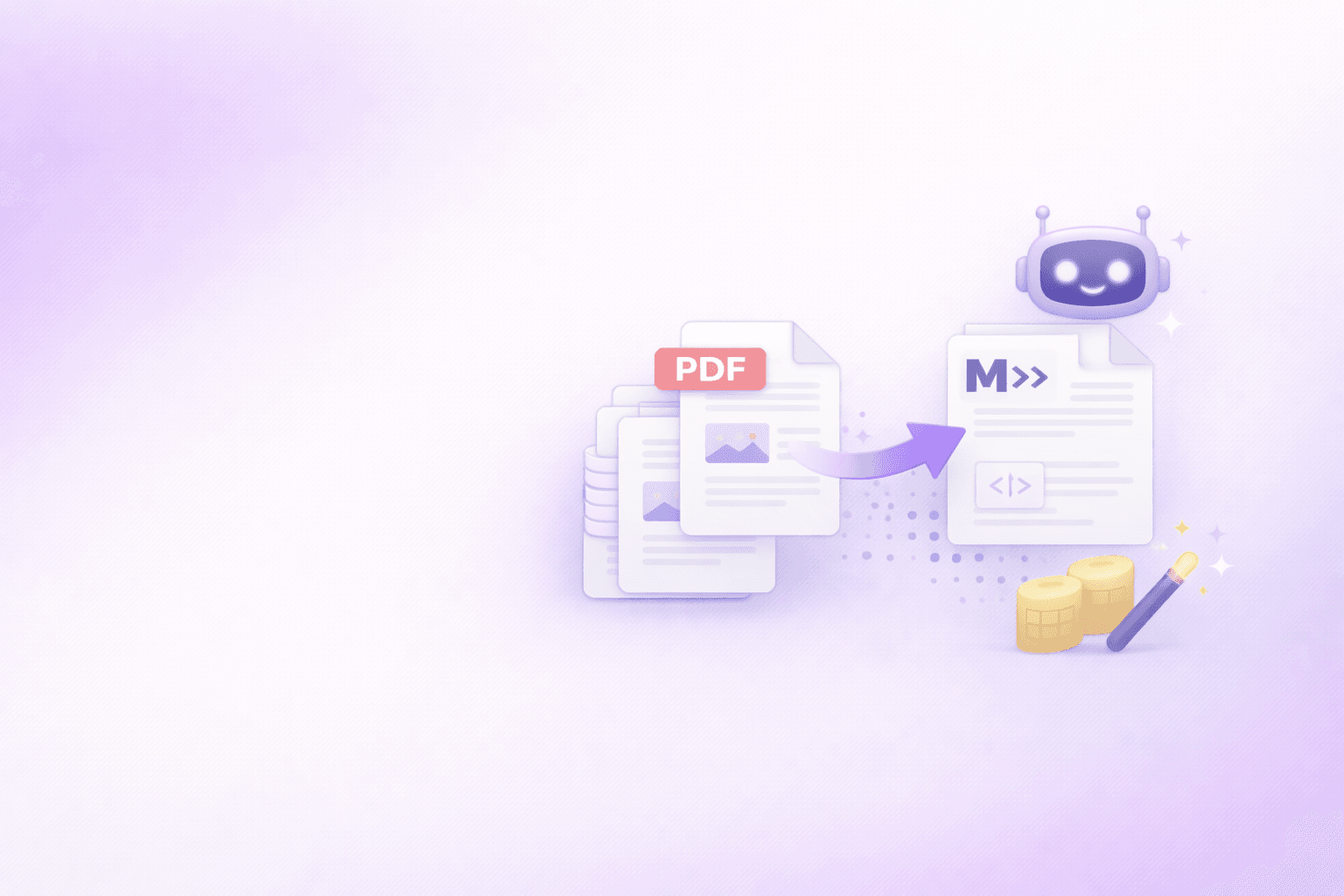
That is why PDF to Markdown for RAG has become a stronger target state than plain-text extraction. Markdown is not magical, but it gives AI systems something raw PDF text usually does not: a lightweight semantic map.
For the document-authoring side of that workflow, Markdown to PDF for Developers is a useful companion piece because it shows how ShellPDFs preserves structure cleanly once content is already in Markdown.
Why standard PDF text extraction breaks AI agent reasoning
PDF is a presentation format, not a semantic authoring format. A PDF page knows where text appears. It does not reliably expose why that text is there or how it should be grouped.
This creates predictable failure modes for AI Agent document ingestion:
Headings lose hierarchy
A document with a clear H1, H2, and H3 structure can flatten into one long paragraph stream. The agent no longer sees which sections are parents, which are subtopics, or where one policy ends and another begins.
Columns merge into nonsense
Two-column layouts often extract left-right-left-right instead of top-down reading order. That corrupts the meaning before the content ever reaches the vector store.
Lists stop being lists
Steps, requirements, exclusions, and exceptions matter in policy and operational documents. When bullet markers disappear, the agent loses ordering and set boundaries.
Tables become prose fragments
A rate card, SLA table, or compliance matrix is no longer a table after flat extraction. It becomes a shuffled collection of cell strings with very weak relational meaning.
This is the real reason agents “hallucinate” over documents. Often they are not hallucinating from nowhere. They are reconstructing meaning from broken upstream structure.
Why clean Markdown is the new standard
Markdown solves a specific preprocessing problem: it reintroduces structure in a form that is both machine-friendly and human-reviewable.
For RAG systems, that matters because chunking is easier when the source already carries explicit boundaries:
#and##headings define topic transitions- lists preserve enumerations and sequence
- blockquotes preserve quoted policy text
- code fences isolate machine-readable examples
- tables remain tables instead of comma-shaped prose
This is why Markdown works well for Document Intelligence pipelines. It sits between raw binary layout and full custom XML schemas. It is compact enough for tokenization, but structured enough for chunking rules that do not feel arbitrary.
Markdown helps LLM tokenization in practical ways
The important advantage is not that tokenizers “understand Markdown” as a special language. It is that Markdown uses small, consistent markers to preserve hierarchy without burying the content in heavy markup.
That helps in three ways:
- Chunks can start and end at natural section boundaries.
- Retrieved passages are easier for the agent to quote faithfully.
- Humans can quickly inspect the transformed document before it enters the vector index.
In other words, clean Markdown makes the ingestion layer debuggable.
The ShellPDFs preprocessing layer: local-first, inspectable, and structured
ShellPDFs does not treat document preprocessing as a black box. The strongest workflow in the current product stack follows a local-first architecture:
- Extract structure locally with PDF to JSON / Excel.
- Normalize that structure into Markdown in your pipeline.
- Review and refine the final Markdown in the Markdown Converter.
- Feed the cleaned chunks into your vector store and agent stack.
This is the key point: the pre-processing layer should be inspectable before it is indexed.
The PDF to JSON / Excel tool is especially useful because it keeps the extraction step in the browser and exposes tables, text blocks, and metadata instead of pretending the PDF was already semantically clean. That gives engineering teams something better than opaque text dumps.
The Markdown Converter then becomes the quality gate. It gives teams a simple, browser-based place to validate heading depth, list integrity, code blocks, and final chunkable structure before anything moves downstream.
Across ShellPDFs, client-side processing is the default where it fits, and Wasm (WebAssembly) is part of the broader strategy for keeping heavier browser workloads local instead of pushing every transformation to a remote parser.
The strongest AI ingestion workflow is not “extract and pray.” It is “extract, normalize, inspect, then index.”
Why this fits Oracle 23ai vector workflows
Oracle introduced Database 23ai in May 2024, and Oracle’s AI Vector Search stack now describes a pipeline that includes document load, transformation, chunking, embeddings, similarity search, and RAG. That is exactly why preprocessing quality matters so much upstream.
If your target platform is Oracle 23ai-era vector infrastructure, clean Markdown improves the stages before embeddings:
- Transformation becomes deterministic because section markers are explicit.
- Chunking can key off heading depth instead of fixed token windows alone.
- Metadata binding becomes easier because titles, subtitles, and lists are visible in plain text.
- Retrieval improves because chunks map to coherent concepts rather than arbitrary page slices.
The same logic applies even if you are not using Oracle. But Oracle is a useful anchor because its current vector-search documentation explicitly treats load, transformation, chunking, and RAG as part of one pipeline rather than unrelated steps.
A practical local-first RAG prep workflow
Here is the workflow we recommend for sensitive document sets:
1. Extract structure, not just text
Use PDF to JSON / Excel so you can inspect text blocks, table data, and metadata locally. This avoids sending proprietary documents to a generic parser just to get a weak text dump.
2. Rebuild hierarchy in Markdown
Map:
- document titles to
# - section titles to
## - subtopics to
### - ordered procedures to numbered lists
- policies and exceptions to bullet lists
- tables to Markdown tables where they remain readable
3. Normalize noisy regions
Fix the parts agents struggle with:
- repeated headers and footers
- merged columns
- split bullets
- broken table rows
- page-number noise
4. Validate the final structure
Use the Markdown Converter as a review surface. If the Markdown reads cleanly to a human, it is usually far more ready for chunking and embedding.
5. Index chunks, not pages
Chunk by section or sub-section, not by page number alone. Pages are print artifacts. Headings are semantic artifacts.
Why local-first preprocessing matters for private knowledge bases
Many teams building internal RAG systems are doing so on confidential material:
- contracts
- customer playbooks
- HR policies
- internal runbooks
- audit narratives
- architecture standards
That is why client-side processing matters here. The extraction and cleanup stage is often where the most sensitive raw material exists. ShellPDFs keeps that early stage browser-based wherever possible, which reduces the number of processors touching the document before it becomes an indexed knowledge artifact.
If your team works from the browser often, the ShellPDFs Chrome Extension is a useful operational detail. It keeps extraction and Markdown cleanup one click away instead of sending people back to search engines and random SaaS tools.
Build cleaner RAG inputs by extracting structure locally and validating the final Markdown before indexing.
Open PDF to JSON / Excel →The new ingestion rule
The old rule was simple: get the text out of the PDF.
The new rule is stricter: get the structure out of the PDF, preserve it in Markdown, and only then build embeddings.
That is the shift from flat extraction to agent-ready content. For modern AI Agent document ingestion, clean Markdown is no longer a nice-to-have formatting choice. It is the difference between a retriever that finds real context and one that keeps sending the model broken fragments.
Frequently Asked Questions
Free Tool
PDF to JSON
Turn any PDF into structured data — tables, text, and metadata — instantly in your browser.
Try PDF to JSONShellPDFs Team
The ShellPDFs editorial group writes and maintains guides for everyday PDF workflows, with updates made when tool behavior or documented limits change. See our editorial standards for the process behind each article.
Focus: Structured document extraction and AI-ready content workflows
Questions or feedback? Get in touch.